
Skip to content

New advances in low-power light modulation
explored a new approach to controlling light emission through the movement of oxygen ions in functional oxide materials. The project aimed to develop energy-efficient, non-volatile optical devices whose response could be continuously tuned using small electrical stimuli, while gaining a better understanding of the processes governing oxygen insertion and extraction in oxide thin films. Praseodymium- and terbium-doped YSZ were investigated as optically active ionic materials, demonstrating that changes in the oxygen environment can modify their photoluminescence. These results showed the potential of combining ionic control and rare-earth emission within a single material platform. Overall, the project established photo-ionic control as a promising route towards analog and non-volatile light emission and modulation. It also identified strategies to improve ionic transport and device performance through material and device optimization. Alicia Ruiz-Caridad, from the Nanoionics and Fuel Cells Dept. at IREC, is a MSCA-PF fellow who led the project and combined IREC's expertise in nanoionics and functional oxides with her background in integrated photonics and rare-earth-doped materials. This interdisciplinary approach enabled the project to progress from material development and fundamental understanding of oxygen-driven optical changes towards their implementation in photonic structures. She will continue to develop this research line at IREC though a Ramon y Cajal fellowship, starting in September. The project resulted in two peer-reviewed journal publications, a patent application and several conference contributions, including two invited talks. Her outreach activities included participation in Matins de Recerca, Festa de la Ciència and Científiques. In 2026, Alicia received the Postdoctoral Research Award at the Photonics North Conference. Overall, PHIDES established oxygen-ion configuration as an effective means of controlling the optical properties of functional oxides. The project demonstrated reversible and analog optical tuning, extended ionic control to rare-earth emission, and provided the foundations for integrating these materials into guided photonic devices. These results open new opportunities for low-power optical technologies in which the material response can be electrically adjusted and retained without continuous energy consumption. PHIDES (project number: 101152905) is a MSCA-PF project which stands for "Photoionic Light Modulators for Electrochromic Devices" started in September 2024 and finalised this August. Link to cordis: https://cordis.europa.eu/project/id/101152905 Funded by the European Union. Views and opinions expressed are however those of the author(s) only and do not necessarily reflect those of the European Union or the European Research Executive Agency (REA). Neither the European Union nor the granting authority can be held responsible for them

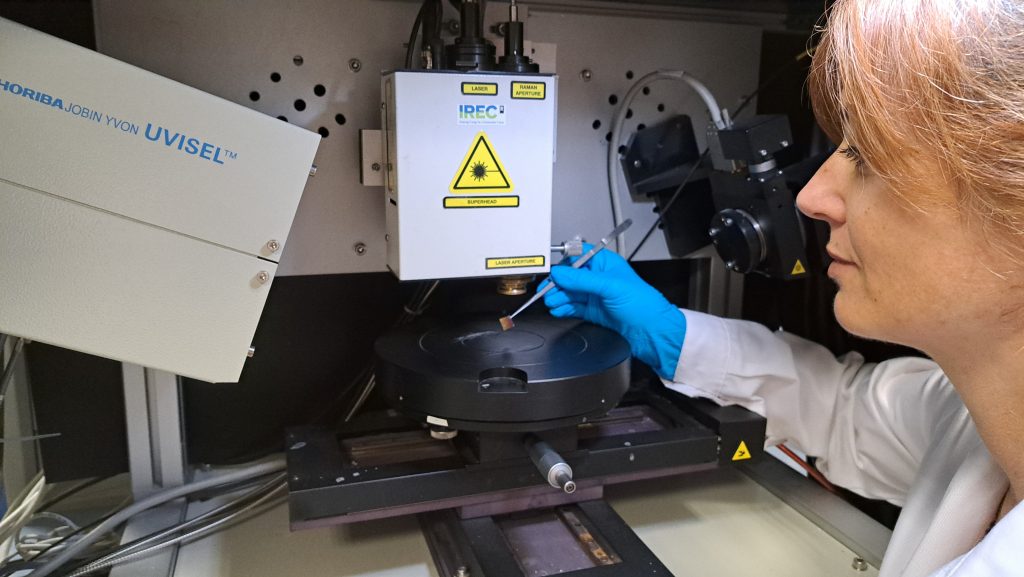
The PHIDES project explored a new approach to controlling light emission through the movement of oxygen ions in functional oxide materials. The project aimed to develop energy-efficient, non-volatile optical devices whose response could be continuously tuned using small electrical stimuli, while gaining a better understanding of the processes governing oxygen insertion and extraction in oxide thin films. Praseodymium- and terbium-doped YSZ were investigated as optically active ionic materials, demonstrating that changes in the oxygen environment can modify their photoluminescence. These results showed the potential of combining ionic control and rare-earth emission within a single material platform.

Overall, the project established photo-ionic control as a promising route towards analog and non-volatile light emission and modulation. It also identified strategies to improve ionic transport and device performance through material and device optimization.

Alicia Ruiz-Caridad, from the Nanoionics and Fuel Cells Department at IREC, is a MSCA-PF fellow who led the project and combined IREC’s expertise in nanoionics and functional oxides with her background in integrated photonics and rare-earth-doped materials. This interdisciplinary approach enabled the project to progress from material development and fundamental understanding of oxygen-driven optical changes towards their implementation in photonic structures. She will continue to develop this research line at IREC though a Ramon y Cajal fellowship, starting in September.  

The project resulted in two peer-reviewed journal publications, a patent application and several conference contributions, including two invited talks. Her outreach activities included participation in Matins de Recerca, Festa de la Ciència and Científiques. In 2026, Alicia received the Postdoctoral Research Award at the Photonics North Conference.

Overall, PHIDES established oxygen-ion configuration as an effective means of controlling the optical properties of functional oxides. The project demonstrated reversible and analog optical tuning, extended ionic control to rare-earth emission, and provided the foundations for integrating these materials into guided photonic devices. These results open new opportunities for low-power optical technologies in which the material response can be electrically adjusted and retained without continuous energy consumption.

PHIDES (project number: 101152905) is a MSCA-PF project which stands for “Photoionic Light Modulators for Electrochromic Devices” started in September 2024 and finalised this August.

Link to cordis: https://cordis.europa.eu/project/id/101152905

Funded by the European Union. Views and opinions expressed are however those of the author(s) only and do not necessarily reflect those of the European Union or the European Research Executive Agency (REA). Neither the European Union nor the granting authority can be held responsible for them.

Institutional logo "Funded by the European Union - NextGenerationEU".

Privacy Overview

This website uses cookies so that we can provide you with the best user experience possible. Cookie information is stored in your browser and performs functions such as recognising you when you return to our website and helping our team to understand which sections of the website you find most interesting and useful.