
Advancing high-pressure solid oxide electrolysis cells
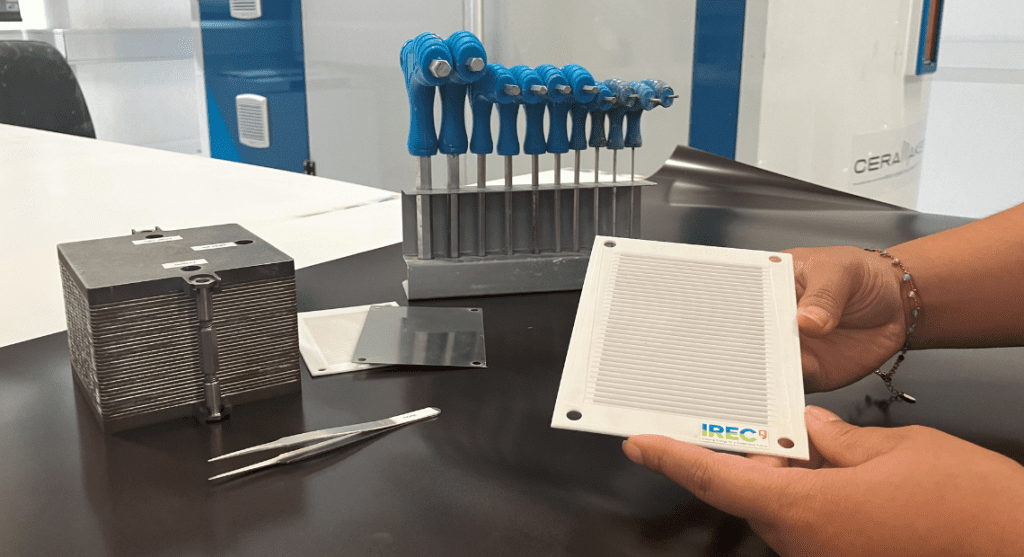
Water electrolysis for green hydrogen production or Power-to-X technologies is one of the most promising solutions to store energy from renewable sources. Among the different types of electrolysis systems, high-temperature Solid Oxide Electrolysis Cells (SOECs) are the most efficient, offering higher production yields and lower specific electricity consumption. However, the need to operate inside expensive and unpractical pressurized vessels remains one of the major limitations of SOEC technologies.
To address this, the SIMP-EL project, which stands for “SIMulation assisted optimization of high Pressure solid oxide ELectrolysis Cells”, aims to design and develop a new generation of highly efficient solid-state energy storage devices based on SOECs able to convert electricity into pressurized hydrogen suitable for direct injection into the grid or tank storage.
The SIMP-EL concept is based on the combination of high-fidelity multiphysics simulations and advanced manufacturing of disruptive geometries for developing microtubular and complex 3D shapes able to withstand high pressure operations without the involvement of pressure vessels, opening the way to the commercialization of high-pressure solid oxide electrolysers and the efficient and cost-effective production of green hydrogen.
Marc Torrell and Antonio Gianfranco Sabato from the Nanoionics and Fuel Cells department at IREC, contributed to the project with the fabrication of new solid oxide cell geometries by stereolithography 3D printing of yttria-stabilized zirconia.
After more than 2 years of research, the SIMP-EL project concluded successfully, demonstrating the ability to operate the 3D-printed ceramic devices at high pressure by tailoring their shapes with the support of high-fidelity simulations and state-of-the-art materials.
The consortium is formed by IREC (the coordinator), Instituto de Nanocienia y Materiales de Aragón (INMA) and Barcelona Supercomputing Centre (BSC).
Acknowledgements (in Spanish)
SIMP-EL (TED2021-131267B-C31) es un proyecto financiado por MCIN/AEI/10.13039/ 501100011033 y por la Unión Europea “NextGenerationEU”/PRTR.
