
MagnOxy advances on ion-driven control of magnetism for next-generation computing
As digitalization accelerated and the Big Data era expanded, the need for faster and more energy-efficient computing architectures became increasingly evident. Traditional Von Neumann systems could no longer keep pace with modern workloads—particularly artificial intelligence—because of the bottleneck created by separating memory and processing units.
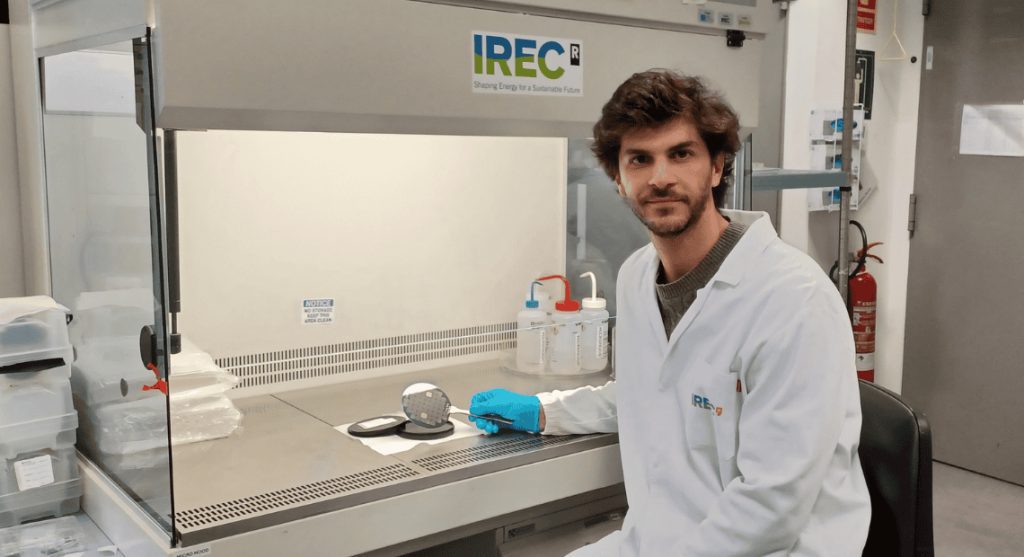
MagnOxy is a MSCA-funded Horizon Europe project that stands for “Magneto-ionic devices based on oxygen-ion solid state intercalation“, which started in January 2024 and has just finalised. This project was conducted by Francesco Chiabrera from the Nanoionics and Fuel Cells department at IREC, under the supervision of Prof. ICREA Albert Tarancón.
MagnOxy addressed this technological challenge by exploring magneto-ionics as a route toward next-generation non-volatile memories capable of operating at low energy and performing logic operations directly within the memory element. The project focused on controlling the magnetic properties of oxide thin films through reversible oxygen-ion insertion, with the aim of establishing a foundation for fast and efficient in-memory computing concepts.
Main outcomes and conclusions
- New scientific insights into oxygen-ion dynamics:
MagnOxy delivered a deeper understanding of how oxygen ions move and insert into oxide thin films. This was enabled by the development of new characterization approaches capable of tracking ion motion with improved spatial and temporal resolution, contributing to the fundamental science of ion–matter interactions in functional oxides. See https://onlinelibrary.wiley.com/doi/10.1002/smtd.202402043 - Demonstration of magnetic control through ion insertion:
The project showed that magnetic transitions in perovskite oxide thin films can be reversibly and analogically tuned by voltage-driven oxygen-ion insertion. This stable and controllable modulation of magnetism marks an important step toward magneto-ionic memory and logic devices. See https://pubs.aip.org/aip/apr/article-abstract/11/4/041426/3327517/Analog-control-of-La0-5Sr0-5FeO3-electrical - Development of neuromorphic device concepts:
MagnOxy also enabled the development of neuromorphic device prototypes in which ion-driven changes in the magnetic state of the material are used to modulate its electrical conductivity. This magnetically controlled transport behavior enables analog and energy-efficient signal processing, highlighting the promise of oxide-based materials for future brain-inspired and low-power computing technologies. See https://advanced.onlinelibrary.wiley.com/doi/full/10.1002/adma.202415743
Link to cordis: https://cordis.europa.eu/project/id/101107093
Funded by the European Union (GA No. 101107093). Views and opinions expressed are however those of the author(s) only and do not necessarily reflect those of the European Union or European Research Executive Agency (REA). Neither the European Union nor the granting authority can be held responsible for them.
