
MAIAMI is the AI platform that will accelerate the development of advanced materials
Artificial intelligence (AI) is transforming the way new materials are designed and discovered, a process that traditionally required long and complex trial-and-error procedures. The combination of advanced algorithms, simulations, and high-throughput experimentation is opening new horizons in this field, allowing thousands of combinations to be explored in reduced time and with unprecedented precision. This creates the need to develop platforms that integrate these tools in a coordinated and responsible way, providing reliable results.
In this context arises MAIAMI (Multimodal Artificial Intelligence Platform for Accelerated Materials Innovation), a pioneering project that will integrate AI into experimental and simulation design, offering an innovative approach to speeding up the development of new advanced materials. The project will be carried out by groups from ICN2 and IREC, which have received 1.4 million euros for its development. It has been selected in the 2025 call for Research Projects in the Field of Artificial Intelligence by the Spanish State Research Agency.
How will MAIAMI work?
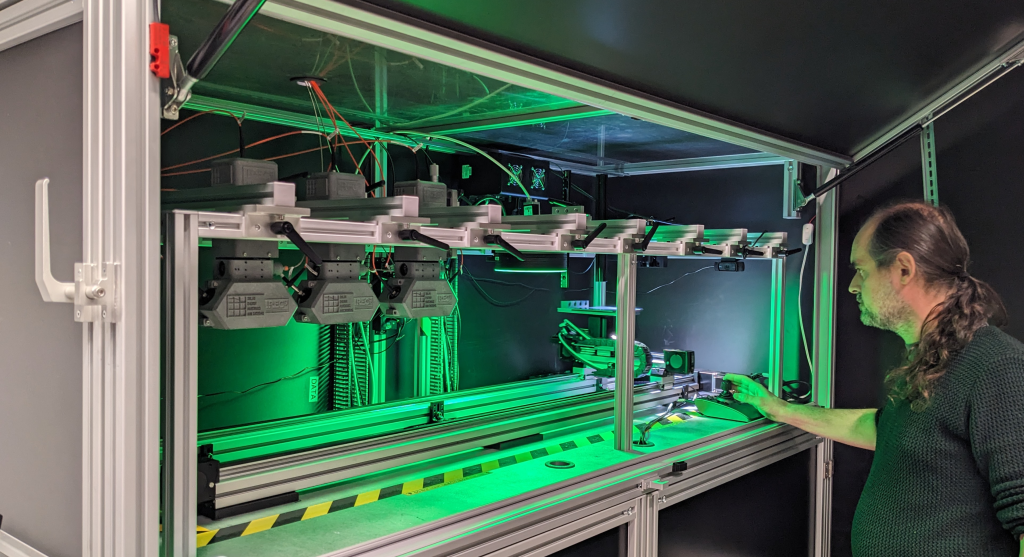
MAIAMI will rely on an advanced robotic system guided by explainable AI, a type of AI that is not only capable of making decisions but also explaining them clearly and transparently. This system will be developed by the IREC team, involving ICREA Prof. Andreu Cabot, leader of the Functional Nanomaterials Department, Dr. Maxim Guc and Dr. Victor Izquierdo from the Materials and Solar Energy Systems Department. The AI itself will guide experiments, interpret results, and define strategies in real time, creating a kind of self-refining “virtual scientific assistant,” capable of improving and adjusting its decision-making process.
“One of the main innovations of the system will be its ability to generate digital twins that simulate material synthesis processes and can predict their properties,” explain Maxim Guc and Andreu Cabot, two of the project’s principal investigators. The platform will also incorporate a responsible approach based on the Human-In-The-Loop concept, where expert researchers supervise and interpret the AI’s decisions.
Innovation for the development of sustainable energy solutions
ICN2 will lead the scientific coordination of the project, focused on developing new technologies for sustainable energy production through advanced simulations and artificial intelligence models. These technologies will rely on high-entropy alloys (HEAs), materials with unique properties such as high stability, corrosion resistance, and strong electrochemical activity, making them particularly attractive for clean energy applications.
Using these alloys, the team will develop electrocatalysts capable of driving key chemical reactions for the energy transition, such as hydrogen production—a green fuel—or the manufacturing of metal–air batteries, which offer the advantage of storing high densities of renewable energy and being made from abundant materials, making them more sustainable.
“The MAIAMI platform will allow all experimental data to be centralized in a traceable database that will feed and refine predictive models, optimizing resources and accelerating the development of new materials and energy technologies,” notes Dr. Neus G. Bastús (CSIC researcher and leader of the Inorganic Nanoparticles Group at ICN2), one of the project’s principal investigators.
Overall, MAIAMI establishes an accelerated discovery model aligned with the objectives of ethical AI and Europe’s energy transition, opening the door to applying this methodology in other sectors related to energy production or the circular economy.
Today, we launched a press release (in Spanish):
Acknowledgements (in Spanish): El proyecto AIA2025-164488-C22 está financiado por MICIU/AEI/10.13039/501100011033.