
MAKING PEDs recognized as a leading innovation for Positive Energy Districts
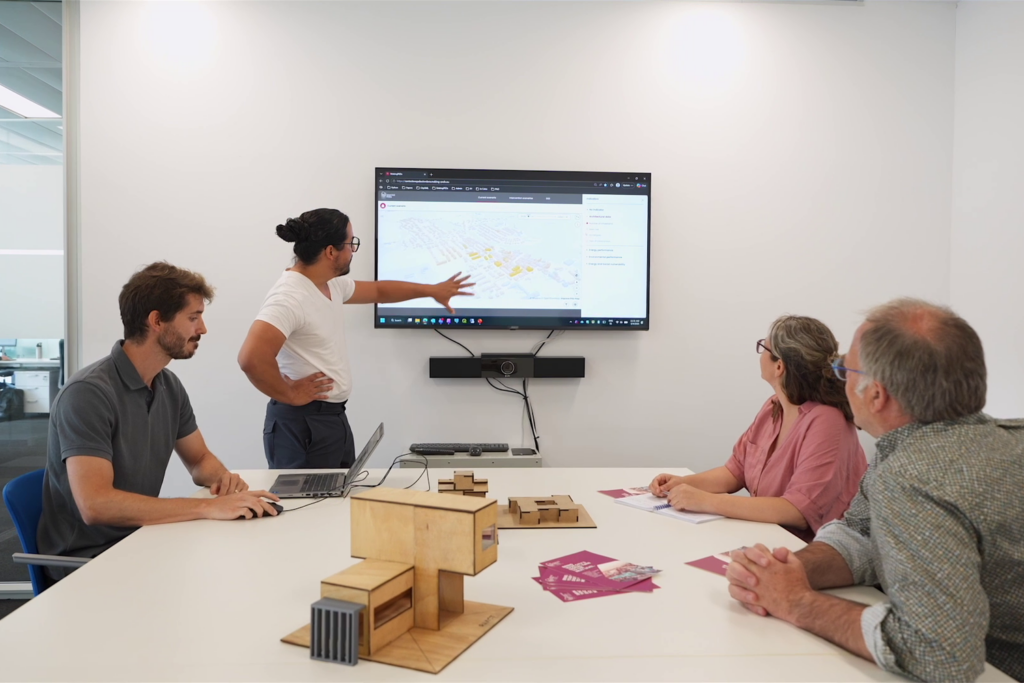
The MAKING PEDs project, coordinated by IREC, has concluded after developing innovative digital tools and methodologies to help cities plan Positive Energy Districts (PEDs) and accelerate their transition towards climate neutrality. Positive Energy Districts are urban neighbourhoods designed to generate more renewable energy than they consume, helping reduce emissions while creating greener, more sustainable places to live.
At the heart of the project is the MAKING PEDs Digital Twin Platform, a decision-support tool that integrates urban data and assessment modules covering operational energy, building embodied emissions, water, waste and mobility emissions, renewable energy and nature-based solutions. The platform connects digital representation of urban districts enabling simulations, scenario testing, and cross-domain analysis of different intervention scenarios, including retrofitting of buildings. The platform integrates 3D city models into a dynamic, interactive environment that supports urban analysis and the planning of PEDs.
The Digital Twin Platform has received significant recognition at European level. Selected as the best innovation in the PED Transition Pathway from the 2022 call, it has also been included in the Driving Urban Transitions (DUT) innovation portfolio showcase, highlighting its contribution to urban climate neutrality and resilience, as well as its potential for replication and scaling.
On 22 October, Jaume Salom, head of IREC’s REACT Department and MAKING PEDs project coordinator, presented the innovation at the DUT Call 2022 Online Final Event, sharing the project’s achievements and lessons learned alongside other innovations developed through the programme.
The platform has also earned recognition in other innovation awards. It was selected as a finalist in the Sustainability category of the eAward 2026 (link) and in the Llavor category of the EmErgEnt Awards 2026, organised by the Catalan Energy Efficiency Cluster (CEEC). Both nominations recognise its innovative approach to urban energy planning. Watch the MAKING PEDs innovation video to discover how the platform supports cities in planning their energy transition.
Beyond the Digital Twin Platform, MAKING PEDs delivered several key innovations to support PED development. These include workflows for creating 3D city models, led by the Norwegian University of Science and Technology (NTNU), and a methodology for stakeholder engagement in PED planning, developed by the Austrian Institute of Technology (AIT).
MAKING PEDs brought together 10 partners from research, academia, public authorities and industry across Europe, including 4 research centres/universities (Univ. Roma 3, NTNU, AIT and IREC), 3 public bodies (City of Linz, City of Bærum and ATER-Civitavechia) and 3 SMEs (CICLICA, R2M and Urban Future). The project was led by Jaume Salom, head of IREC’s REACT Department. Joana Ortiz, Jakob Spohr and Carlos Chang contributed to the integration of PED calculation methodologies from a holistic life-cycle assessment perspective.
The work now continues through Scale-UP MAKING PEDs, which builds on the project’s results to support the implementation of Positive Energy Districts, addressing both neighbourhood-specific and city-wide applications. The new project will further develop the Digital Twin platform and explore its application with a focus on interoperability, replicability and scalability.
Acknowledgements (in Spanish): El proyecto Making PEDs (DUT European Partnership) está financiado por el Ministerio de Ciencia e Innovación, la Agencia y, en su caso, la Unión Europea (Proyecto F-DUT-2022-0186 financiado por MCIN /AEI/10.13039/501100011033/UE).
