
Ultrathin reversible solid oxide cells to store renewable electricity
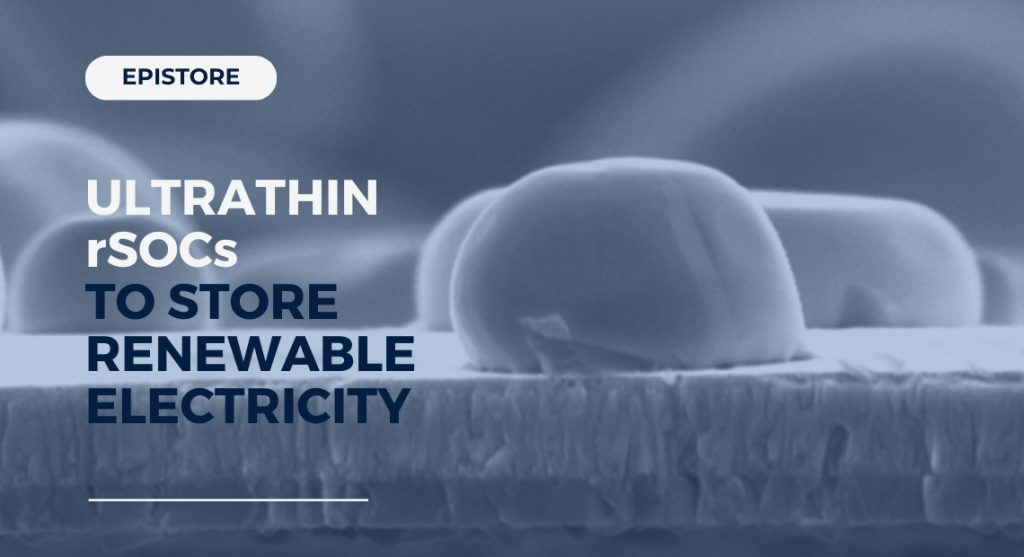
Solid oxide cells (SOCs) have the potential to revolutionise the storage sector due to their high efficiency and their ability to operate in both electrolysis and fuel cell modes (reversible SOCs). However, they present several challenges such as challenging operation under pressure, slow start times, size, and heavy reliance on critical raw materials.
To address this, the EPISTORE project aimed to deliver a new family of superior performing ultrathin reversible SOCs (rSOCs). The thin film nature of the EPISTORE cells would enable the implementation of major breakthroughs, from emerging fields such as nanoionics or nano catalysis and new materials, while paving the way for cost-effective and scalable energy storage with a reduction of >99% in the use of critical raw and high supply risk materials.
After 4.5 years of intensive research, the EPISTORE project has achieved the improvement of commercial SOCs by using thin film nanocomposites while reducing the amount of electrode material by 99%. By implementing high entropy oxides and low temperature exsolution at the fuel electrode, they managed to improve cell stability at high current densities and lower the temperature of operation of SOCs. Additionally, low temperature deposition techniques were used to produce highly efficient and stable Co-free oxygen electrodes. EPISTORE also achieved the production of freestanding complete solid oxide cells with submicron thickness and tenths of centimetre in diameter, marking significant progress toward practical and cost-effective energy solutions for applications where batteries are inefficient due to size limitations or long-term storage needs.
Moreover, the consortium attained major scientific breakthroughs. They used machine learning to predict material properties, employed computer simulations to understand the behaviour of grain boundaries, and used advanced techniques to understand chemical processes on material surfaces in real time. Also, EPISTORE’s scientific contribution is shown by more than 45 scientific papers, more than 70 conferences and three patents.
The consortium is formed by IREC, CSIC, the University of Cambridge, Karlsruhe Institute of Technology (KIT), the University of St Andrews, the Imperial College London, CNRS, RWTH Aachen, Johnson Matthey, Solydera, Solmates, HyGear and Technische Hochschule Deggendorf. The project is led by Albert Tarancón, Prof. ICREA and head of the Nanoionics and Fuel Cells department, along with Kosova Kreka, Alex Morata, and Nerea Alayo. Moreover, Federico Baiutti, Juande Sirvent, Fjorelo Buzi, Marlene Anzenbruger, Lucile Bernadet, Francesco Chiabrera from IREC, have given major contributions in the scientific outputs of this project.
Acknowledgements
This project has received funding from the European Union’s H2020 research and innovation programme under grant agreement number 101017709.
