
UncorrelaTEd achieves important improvements in efficiency in thermoelectric materials
The European Project UncorrelaTEd, which began its activity on January 1st, 2020, has concluded after 4 and a half years of hard work. The project sought to develop a new technology to increase the efficiency in the conversion of heat into electricity through a new concept based on the combination of porous thermoelectric materials with electrolytes (medium with ions, such as dissolved salt in water).
It is estimated that currently 72% of the world’s total energy consumption is lost as waste heat. This amount of energy is so large that recovering only 10% would exceed the sum of energy generated by most current renewable energy sources (solar, wind, geothermal and hydraulic). Apart from this overwhelming claim, heat is ubiquitous and many sources of heat, such as the sun or even our own body, are widely available.
A technology capable of converting heat into electricity is thermoelectricity. However, thermoelectric materials, among other problems, do not have the appropriate efficiencies to be applied extensively. Achieving high efficiencies would have a great impact and would contribute to mitigating the current energy problem.
All the machines, from jet engines to microprocessors, generate heat, as do manufacturing, domestic and even biologic processes. For example, the Internet of Things (IoT) development, which will lead to a new concept of society (society 5.0) with unprecedented benefits, is currently seriously limited by the use of batteries. High thermoelectric efficiencies could lead to self-powered sensors (e.g. from body heat, industrial exhaust gases, ambient heat), eliminating the need for batteries and their associated maintenance costs, and harmful environmental impact. Textiles are another sector in which thermoelectric materials can be integrated to power devices such as implantable electronics and wireless monitoring systems for healthcare.
The UncorrelaTEd approach
UncorrelaTEd aims to connect thermoelectricity with electrochemistry using a new system formed by a porous thermoelectric solid permeated by an electrolyte (liquid or gel). The goal is for this electrolyte to tactically interact with the solid to increase the system’s efficiency. Members of UncorrelaTEd had already observed unprecedented improvements in efficiency using a material with modest thermoelectric properties. Using this as starting point, the objective of the UncorrelaTEd project was to extend these improvements to different families of thermoelectric materials with good initial properties (Bi and Te alloys, oxides and polymers), thus trying to reach efficiencies at least 4 times greater than the current ones.
After the completion of the project, important scientific results have been achieved that have resulted in 2 patents, 16 scientific articles and 3 doctoral theses. Although the initial improvements could not be extended to Bi and Te alloys or polymers, improvements of around 4 times in efficiency in oxide materials have been observed, specifically in ZnO.
On the other hand, a new system for measuring the thermal properties of liquids based on a thermoelectric device has been developed, and the theoretical foundations of a system that can give rise to extraordinary high efficiencies using a specific combination of solid material and electrolyte have also been established. In addition, antimony-doped tin oxide has been identified as a low-cost element capable of replacing the extremely expensive platinum in thermogalvanic cells.
Lastly, new efficient methods of preparation of nanostructured bismuth telluride assisted by microwaves have been developed, and an advanced simulator of thermoelectric properties for porous nanostructured systems has been made available in open source.
It is expected that, as research progresses, the future development of the results generated in this project will give rise to the expected impact, thus contributing to mitigate the current energy problem.
The consortium
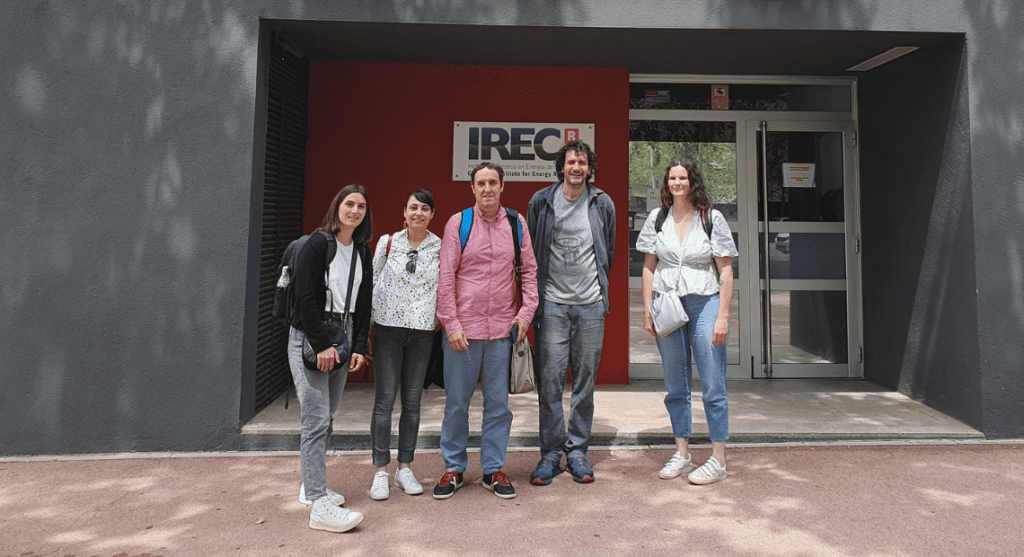
The activities of the project have been implemented by 6 European partners, coordinated by the Universitat Jaume I from Castelló de la Plana, Spain. The Kungliga Tekniska Högskolan (KTH), Sweden; the Institut de Recerca en Energia de Catalunya (IREC), Spain; and the company Specific Polymers, France, worked on the preparation of porous thermoelectric materials (Bi and Te alloys, oxides, and polymers, respectively). Specifically, IREC developed oxide materials with high electrical conductivity based on Ag-doped ZnO with excellent thermoelectric properties. On the other hand, the Universitat Jaume I integrated these materials in different electrolytes and evaluated the improvements in efficiency. The company Solvionic, France, participated in the synthesis of solid electrolytes and ionic liquids. Lastly, the University of Warwick, United Kingdom, performed simulations to help understand and develop these new systems.
Acknowledgements
This project has received funding from the European Union’s Horizon 2020 research and innovation programme under grant agreement No 863222.
