
WEDISTRICT project concludes demonstrating new renewable energy DHC concepts
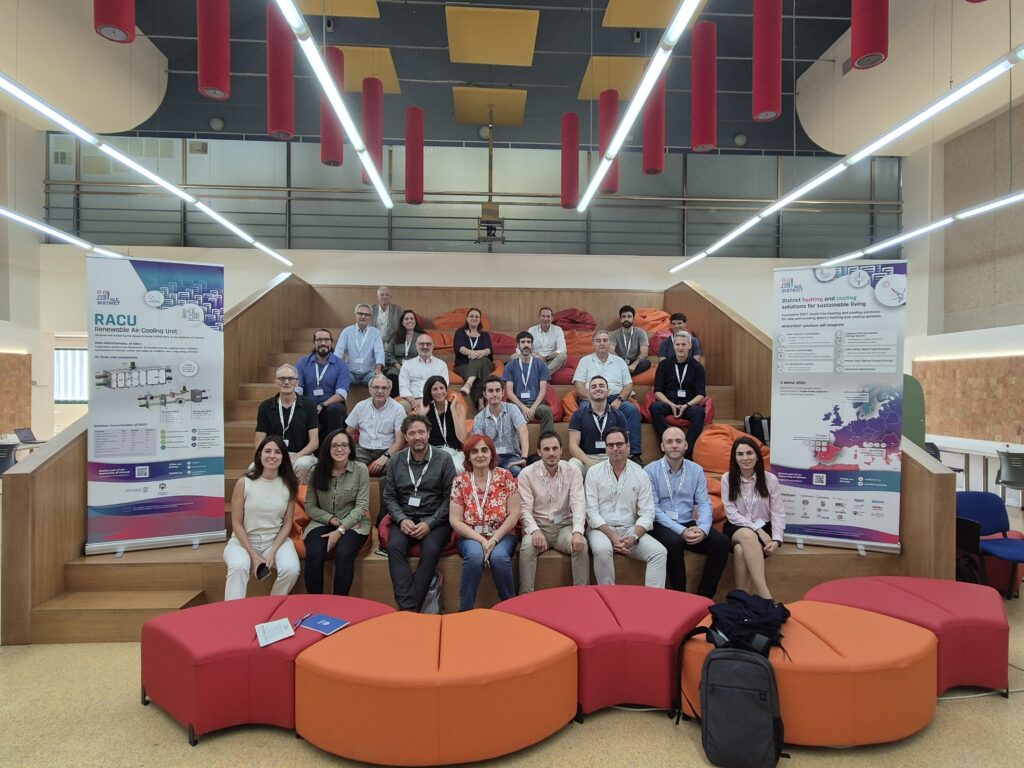
The WEDISTRICT project concluded this semester in September 2024 with a final meeting on September the 25th at the University of Cordoba, host of the last of the last demonstrator build within the project. This event closed a cycle started in October 2019 in Madrid and that brought the consortium to build three demo-sites.
The main goal of the project was to demonstrate solutions and concepts for 100% renewable district heating and cooling. In order to achieve this goal, 3 demo-sites were built to integrate and demonstrate the 10 different technologies that were either developed or improved within the project.
The Bucharest (Romania) demo-site presented the refurbishment of an existing district heating network through a concept of hybridization of geothermal heat pumps with a photovoltaic (PV) system, all controlled under an advanced digitalization platform developed within the project. The hybrid system achieved to supply the heat pumps 100% with the electricity generated by the PV on an annual basis.
The Cordoba (Spain) demo-site presented a new district heating and cooling system to supply a university campus. This case presented a challenging integration of different technologies as it included new low-emission biomass boiler, improved Fresnel and parabolic trough solar concentration collectors, innovative flat concentrating solar collectors, advanced absorption chillers and air conditioning units with renewable energy. The demo-site demonstrated the capacity of renewable energies to supply heating and cooling to campus buildings through combined management of the different technologies, hence also achieving 100% renewable supply of heat and cold.
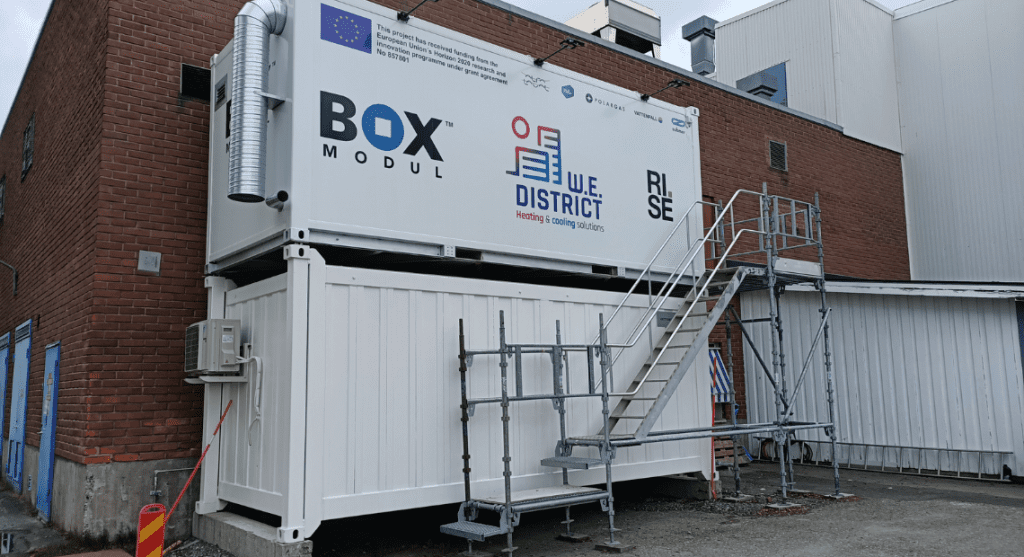
The third demonstrator was located in Luleå (Sweden) and aimed to demonstrate waste heat recovery of a new concepts of energy supply to data centers. The demo-site integrated immersion cooling data centers, solid oxide fuel cells and waste heat recovery to the district heating. The solid oxide fuel cells allowed the data center to operate with renewable biogas, while the immersion cooling provided with higher temperature which eased the waste heat recovery. Both systems were electrically and thermally integrated to improve energy efficiency and enable heat delivery to the district heating network.
Beyond the experimental demonstration of technologies and integration concepts, the WEDISTRICT project aimed to showcase the replicability of the results beyond the demo-site of the project. Therefore, extensive simulation models were developed and validated with the experimental data. These were used to evaluate the impact of WEDISTRICT concepts into a community of demo-followers, which received a detailed report on the analysis of different combinations and recommendations for the most promising solutions. Finally, the models were used to develop the WEDISTRICT tool, a web-based tool to quickly assess the potential of different heating and cooling concepts.
The Thermal Energy and Building Performance Department at IREC contributed extensively within the project by leading a work package, participating in the design, conceptualization and analysis of the Luleå demo-site, as well as contributing to the simulation activities and the development of the WEDISTRICT tool. Joaquim Romaní coordinated IREC’s participation in the project and lead the WP2, in which the evaluation framework and the KPI were defined. Paolo Taddeo participated actively in the design and conceptualization of the Luleå demo-site, carrying out the experimental test of the immersion cooling system and the solid oxide fuel cell, as well as contributing to the modelling of the system. Santiago Escudero participated in the simulation activities of the project, carrying out the evaluation of IREC demo-follower case as well as the simulation associated to the WEDISTRICT tool. Aleksandar Ivancic provided his experience in district heating and cooling in the definition of the evaluation framework as well as the design of the demo-sites.
The consortium is formed by ACCIONA, DHECO Energías, ATOS Spain, Eviden, RAMBOLL, CEPSA, NUSTPB, RISE, IREC, ESCI, R2M France, SOLTIGUA, SEENSO, CER, Fertiberia, UCO, ISPE, Aalborg CSP, UPM, PTER, KAPE, AAF and URV.
This project has received funding from the European Union’s Horizon 2020 research and innovation programme under grant agreement N°857801 (WEDISTRICT).
